Sunday, 12 May 2013

So you want to be a high performer?

The high achievers in business, the arts, sport, family life or any other pursuit realise the value of one important commodity ahead of all others.

This is a commodity that nobody gets more or less of than anybody else and it is free to us all.

I am talking about "Time".

We all get 168 hours per week so how is it that some people achieve more than others in any given week, month, year or lifetime? The person that gets the best results almost always is using time more effectively than anybody else. In other words they invest more in the time they have available and invest with greater intensity. 

So how do they do that?

Firstly...they know time is precious and finite for us all so they rarely waste it on trivial things. Once that time is gone or that moment passes it doesn't come back again so they make the most of it right there and then.

High achievers are nearly always very effective at delegation because they know by doing this they can invest more time into their top priorities. In other words...to be a high performer they must outsource the small stuff to open more time to focus on the big stuff. It's not optional.

The same goes for business. In any given week if your team has more time to focus on the companies biggest goals then it stands to reason you will beat your competitors and be more successful. Although it's become a bit of cliche I firmly believe that you shouldn't sweat the small stuff. Outsource it cost effectively so your team is focused on more important and dollar productive activity.

I am not advocating you become a complete workaholic. You still need to rest to rejuvenate yourself. It's just about finding the balance of rest (not laziness) versus work so you can perform at your best in the time you create. Top athletes and even race horses need to be rested so they can go harder when it counts. We are no different.

Pressure makes diamonds so I believe in creating this pressure by pushing yourself outside your comfort zone continually.

All for now,

+Brad Skelton 

Tuesday, 26 March 2013

We go deeper!


I created Depth Industries to help our customers in the new truly globalised economy where the internet & modern cargo transportation have radically changed the competitive landscape forever.

We understand that increasingly most industries are becoming commoditised so delivering our customers the service they need at world best prices is the key to our own success. To enable us to do this we have adopted the latest Cloud based technologies and lean business overhead models ourselves. 

Distance doesn't matter anymore so Depth Industries businesses aim to support our clients in conquering their chosen market not just at home, but internationally from wherever they are in the world by deeply understanding their needs and delivering on them.

To do this a few of the key things any business needs today are:
- Competitive International shipping and freight forwarding services.
- A global workforce paid at internationally competitive rates.
- Capital to grow.

That's why Depth Industries operates these companies:-

Depth Logistics is the choice of heavy industry in shipping and consulting on moving project and heavy cargo all over the planet for companies involved in earth moving, mining, construction, petrochemical and energy production related industries.

Depth Offshore is an offshore outsourcing facilitation business helping companies save money by accessing a global workforce. With internet technologies there is virtually no limit to the business tasks that can be easily and successfully outsourced offshore with our help. Savings up to 75% of a comparable western country salary can be achieved. Offshoring tasks is now one of the key enablers in high performance organisations.

Depth Global is a venture capital firm specialising in early stage start up companies run by passionate entrepreneurs playing by the new global economy rules.

+Depth Industries  can be followed on Google+ for access to special offers, deals and business insights.

I hope that Depth can be of service to you and your business soon. We would be very grateful for any opportunities you give us.

Deep enough for now,

Monday, 5 November 2012

First solar powered boat to circumnavigate the world


Back in September 2009 I posted a blog about NYK working on designing a Super Eco cargo ship to have it in service by 2030 using a combination of renewable energies. Well perhaps this is now a step closer thanks to what has been learned by the PlanetSolar team.

The "Turanor" PlanetSolar catamaran completed the first solar powered circumnavigation of the world in May this year. Take a look at this video to see this amazing vessel.


The round the world trip it has undertaken has made it the symbol of energy efficiency and sustainable energy.  The "Turanor" is 95Tonnes in weight, 35m long, 23m wide and 6.1m high and has 537m2 of solar modules. The boat can propel itself at speeds up to 15knots without adding pollution of any kind as it is completely silent. It cost £10million to build and set many records as it circumnavigated the globe.

Commercialisation of solar powered ships surely is just around the corner. Who would have thought a Toyota Prius' would be commercialised into taxis as fast as they have.

By the way, is it just me or does everyone else seem to end up with a Prius every time you call a taxi these days?!

All for now,

Brad Skelton

The Shipping Bloke


Sunday, 4 November 2012

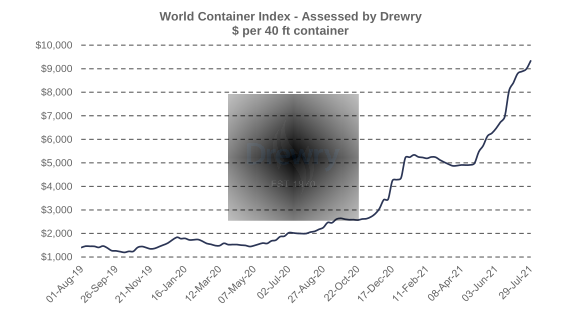
40' container rates between Shanghai and Rotterdam spike up $788 last week!

Most container lines in the world are still struggling with over-capacity in ships for the current world cargo transportation task and little or no growth is forecast in cargo volumes in the coming year.

A break even result is the best many of these shipping lines can hope for with the prevailing market conditions. Despite over-capacity in ships which usually leads to lower freight rates, last week a huge and key market segment from China to Europe saw a massive increase in rates of $788 per 40' container/FEU(Forty foot Equivalent Unit). That is a 38% increase in a single week taking the average cost to ship a 40' container to US$2865.00.

(source-World Container Index)

As you can see by the rate history over the last year, rates at some stages have tripled and between January and July, effectively quadrupled.

What is causing this upward volatility when the usual rules of supply and demand suggest rates should be going lower?

Carriers are endeavouring to remove tonnage from some trade lanes to address the vessel over-capacity but the delivery of a profitable bottom line for them is the real driver after the terrible losses many of them have suffered the past couple of years. Ship owners are being forced to increase rates to ensure they stay profitable and are here in the long run. Slow steaming is still commonplace to keep fuel and operating costs to a minimum.

In my opinion we are going to see tremendous rationalisation and consolidation with shipping lines in 2013 and continued rate volatility. It just has to happen as charter rates are still low and they just can't keep carrying on with the financial performance of the last two years.

I would suggest that not only for the shipping industry but many other industries, "Volatility" is the new normal business environment that everyone has to get used too. Being lean, debt free, commercially agile and nimble will give operators the best prospects of survival.

All for now,

Brad Skelton

The Shipping Bloke


Friday, 21 September 2012

Shipping Line Fuel Surcharges... Blatant Ripoff?


(You are getting this note because you subscribed to The Shipping Blokes Blog by Brad Skelton)

Fuel for ships is known as "bunker fuel" and since the global financial crisis(GFC) bunkers have fluctuated dramatically with a sharp drop post GFC followed by a dramatic increase.

I am amazed at how different carriers apply or choose not to apply bunker surcharges of one description or another even when they operate in the same markets and source their fuel from the same place. Of course the carrier charging it claims they are bleeding and simply can't afford not too. I always enjoy the the look of terror on the sales reps face when I ask how come their competitor isn't charging it and has nearly identical cost structures. I am yet to ever get a plausible explanation.

The carriers that do apply a surcharge most commonly call it B.A.F. This stands for Bunker Adjustment Factor. Another one used by one RoRo carrier is E.F.A.F which stands for Emergency Fuel Adjustment Factor. The word "Emergency" always puzzles me too. Where is the emergency when bunker prices are falling? It's really just marketing spin to help justify a charge that perhaps isn't fair in the first place both in it's conception and it's application.

Another puzzling aspect is why does the application of BAF or EFAF not follow oil price increases and decreases exactly?

When a carrier prices a shipment the rate is made up of a few components. Vessel cost (whether it be charter fees or repayments to banks), part of the port fees, fuel and administration costs. Why then do carriers apply their BAF of say 55% to the components other than fuel? This is another thing any shipping line sales rep is yet to be able to explain to my customers and I.

By the way, how can you possibly charge 55% anyway? That's enormous and surely far outweighs the actual fuel cost itself.

Where there is confusion in terms, or emergencies, there is scope to squeeze more money out of the shipper in the end. I think it's about time some shipping lines came clean and stop the games and rip off. The market can't afford it any more.

My clients and I would rather see all carriers drop this charge altogether and build their fuel costs into their freight rates like most other transportation operators do whether via road, rail and air.

What could be more transparent than that?

All for now,

Brad Skelton

The Shipping Bloke

Monday, 20 August 2012

No doubt about the Canadians..a FTA with the EU.


(You are getting this note because you subscribed to The Shipping Blokes Blog by Brad Skelton)

It has barely been reported in the media around the world but one of the worlds biggest mining and resource nations, Canada, is hurriedly trying to secure a Free Trade Agreement (FTA) with the European Union. A truly brilliant move in my book.

Mines in Europe are generally all but depleted so the primary resources need to be shipped in from somewhere so Canada is setting about ensuring it becomes the most competitive supplier possible by removing import duty and taxes on it's resources. No mining or carbon taxes being applied there unlike with the Canuk's biggest competitor, Australia.

Canada needs the business as the resources landscape in Canada is changing. Traditionally Canada has been a big energy supplier to it's southern cousin, the USA. However this is changing as the USA is increasingly using fracking technology to get natural gas out of places once thought impossible so the need for Canadian energy is diminishing.

Another reason is that with uncertain global economic conditions and generally slowing GDP growth in most regions of the world, it is only prudent to try and create conditions that lock in one the worlds biggest consumers as a customer, the EU.

On the otherside of the Atlantic with an FTA in place, a debt ridden Europe will no doubt love selling and shipping more BMW's, Gucci and Louis into Canada without import duties as well.

As a proud Aussie I am frustrated that my country isn't doing all it can to beat the Canadians to the punch with the EU. In fact we seem to be doing the opposite which will ultimately be at our peril. I think we have too much reliance on the Chinese buying our natural resources.

By the way, the cost of shipping from Canada to China is not that different from Australia so I think we better watch our backs as the Canadians are proving to be leaner, meaner and more agile and I'm sure are working hard on winning over our biggest customer.

Australia needs to take a leaf out of the Canadian's book with the EU and quickly get FTA's with our biggest trading partners and remove taxes that make us a less competitive supplier.

By the way, a little bit of intervention by the Aussie Reserve Bank to get our dollar down from 1.05 against the USD would help our exporters out a hell of a lot too!

What part of "exports bring money into the country to deal with debt and help us prosper" don't our regulators get?!

All for now,

Brad Skelton
The Shipping Bloke